
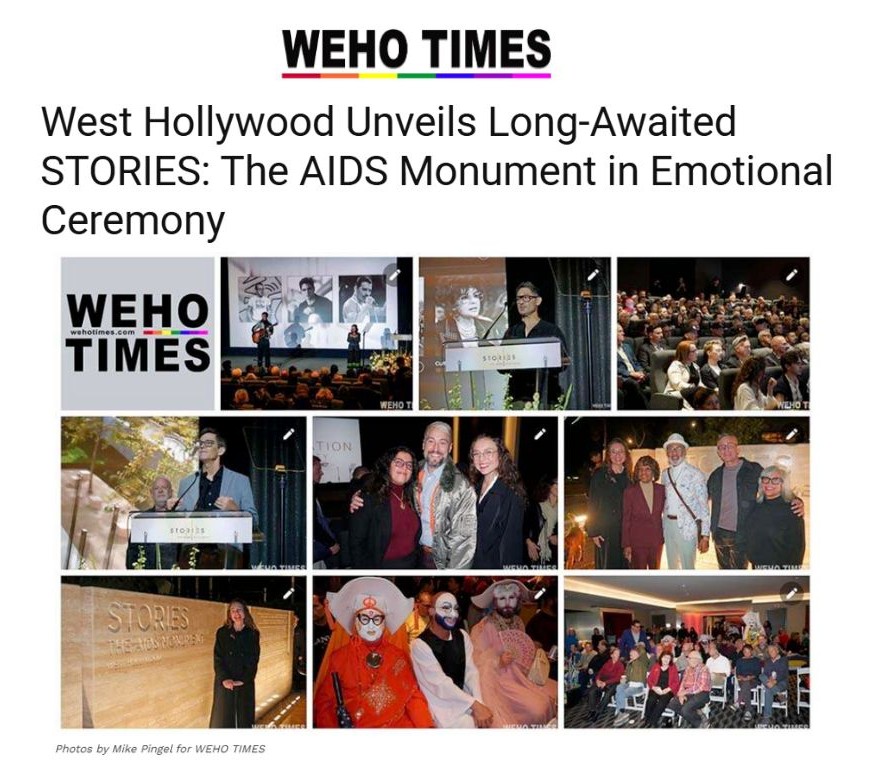
WeHo Times coverage of Monument Grand Opening
West Hollywood Unveils Long-Awaited STORIES: The AIDS Monument in Emotional Ceremony
By Mike Pingel
WeHo Times
November 17, 2025
After years of planning, fundraising, and community advocacy, West Hollywood unveiled the long-awaited STORIES: The AIDS Monument on Sunday evening, marking one of the most significant public memorials dedicated to the AIDS epidemic in Southern California.
The ceremony, originally planned for the outdoor plaza of the Pacific Design Center, was moved indoors to the SilverScreen Theatre due to rain. Guests filled the blue-building venue at 750 N. San Vicente Blvd., with overflow crowds watching live TV feeds in the lobby and an additional viewing space. Seating was first-come, first-served, and attendees lined up well before the 4 p.m. start time.
The program opened with a musical performance by Jake Wesley Rogers, followed by an invocation from Reverend Roger Culberson. Throughout the evening, speakers and presenters emphasized the monument’s role in remembrance, healing, and truth-telling, with images projected in the background of lives lost to AIDS.
Craig Juhlin and Mark Lehman, key figures behind the project’s development, spoke about the monument’s evolution and the years-long effort to bring it to life. Irwin Rappaport, who chaired the initiative, guided much of the program and introduced several video segments tracing the monument’s history — including one highlighting the former West Hollywood Park pool, once a gathering space for gay men before the AIDS crisis reshaped the community.
Actress Alexandra Billings delivered an emotional reading about her personal connection to the AIDS epidemic, pausing to take a selfie with the audience before reflecting on the cultural memory of the crisis. Dr. David Hardy, an HIV/AIDS specialist dating back to the 80s, followed with remarks detailing the medical history of the epidemic and the countless lives lost.
The event also featured short films by The Unit and a tribute narrated by Lily Tomlin, set to music from the 1982 film Making Love.
Members of the West Hollywood City Council, including Mayor Chelsea Byers, offered remarks on the city’s decades-long leadership in HIV/AIDS advocacy. Los Angeles County Supervisor Lindsey Horvath was in attendance, along with community advocates John D’Amico, Phil Wilson, and Maria Roman, the latter speaking about the often-overlooked experiences of trans people during the epidemic.
Longtime HIV advocate Karl Schmid spoke about living with HIV today. Paul Katami and Jeff Zarrillo, plaintiffs in the federal lawsuit that successfully overturned California’s Proposition 8, also addressed the audience.
Notable attendees included Congresswoman Maxine Waters, former West Hollywood Council members and mayors Sepi Shyne, John Duran, and John D’Amico, Los Angeles County Assessor Jeffrey Prang, and City Manager David Wilson, among others.
The program concluded with some words from Tony Valenzuela of the ONE Institute, which will steward the monument’s ongoing storytelling platform, followed by a performance by members of the Gay Men’s Chorus of Los Angeles.
Some attendees braved light rain to visit the monument after the ceremony, then made their way to an after-party at The Abbey WeHo.
Sunday’s unveiling marked a profound milestone for a project more than a decade in the making — a monument designed to preserve the stories of those lost to AIDS and honor the activists, caregivers, survivors, and loved ones who shaped a generation of advocacy.
Located in West Hollywood Park, the new monument features interactive storytelling elements that integrate light, sound, and sculpture in a design by artist Daniel Tobin. The installation aims to educate visitors about the early years of the epidemic while acknowledging the ongoing global fight against HIV/AIDS.
“Tens of thousands of Americans are infected with HIV each year,” reads a statement by the Foundation for the AIDS Monument (FAM). “This monument reminds us to never forget our history and inspires us to continue the fight for equal access to health care, expanded civil rights, and a cure.”
More information about the monument and future programming is available at aidsmonument.org.
To view more WeHo Times photos of the event, click here.