
Beverly Press coverage of Monument Grand Opening
AIDS Monument dedicated in West Hollywood
By Rance Collins
Beverly Press / LaBrea News
November 19, 2025
Against a backdrop of a gray sky and steady rainfall, the city of West Hollywood dedicated STORIES: The AIDS Monument at West Hollywood Park in a somber, yet celebratory, ceremony on Nov. 16.
“The idea for the AIDS monument came to me back in 2010,” monument co-founder Craig Dougherty said. “The AIDS crisis was a formative influence on my life as a young man, as it was for millions of people all over the world … but in 2010 as I spoke with young people, and young gay men in particular, so many knew so little about the AIDS crisis. So, I drafted a position paper laying out a vision for this memorial, which we would call a monument, because the AIDS crisis was not over.”
The landmark represents a mile marker in the city’s history. Just three years after the beginning of HIV/AIDS epidemic, West Hollywood officially became a city. It has, per capita, the highest percentage of LGBTQ+ residents in the country, and HIV/AIDS disproportionately affected its residents throughout the 1980s and ‘90s.
The dedication event was held partially inside the Pacific Design Center across the street, where city and state officials, as well as residents, survivors and video packages, spoke to the significance of the monument and the history of the crisis.
“This is a story of devastation,” AIDS Monument Board Chair Irwin M. Rappaport said. “Everyone we lost to this disease was unique. Everyone deserves the same love and respect, and when we lose a family member or a close friend, the emotional impact of that loss can’t be captured in statistics, but it’s still important to look at statistics, because they convey the enormity of the collective loss suffered by families and friend groups, each of whom lost someone unique, someone they loved.”
Rappaport read some of the statistics, his voice cracking with visible emotion, as he explained that between 1992-96 AIDS was the leading cause of death for men 25-44 years old in the United States. By 1995, one in 15 gay or bisexual men aged 25-44 had died. Other communities, including people who had received blood transfusions, babies born to HIV+ mothers, intravenous drug users and the hemophiliac community, were also affected.
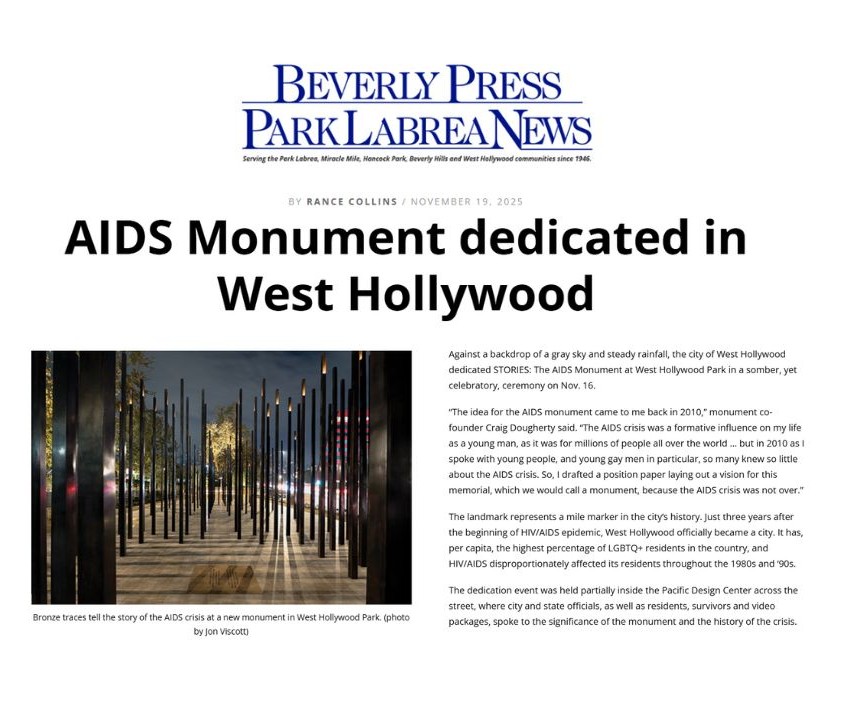
The art piece consists of 147 bronze pillars – called traces – and each is 13 feet tall and 4 inches wide, although their colors vary slightly, bringing a unique quality to each trace. They represent both people who were lost and people who marched and attended protests and vigils. A protest gathering space is located to the side of the traces. It was designed by Australian artist Daniel Tobin – a man living with HIV – the co-founder of the organization Urban Arist Projects.
The location, adjacent to the West Hollywood Aquatic and Recreation Center, is at the site of a former one-story rec center, which had a municipal pool. There, the team known as the West Hollywood Swim Club, later West Hollywood Aquatics, practiced. They had previously been working out at a Los Angeles City pool but were evicted without notice as the AIDS crisis began. After West Hollywood became a city on Nov. 29, 1984, the team was welcomed – according to member James Ballard – with open arms.
“No one felt safe, but in diving into the water, we could escape and feel the beauty of living,” Ballard said. “It became our freedom. Swimming was living. Now, four decades later, we swim in a new pool that has a view of the bronze traces, and we know that they will carry the light of our team into the heavens.”
West Hollywood Park is located at 647 N. San Vicente Blvd. For information about the monument, along with 125 oral histories related to the history of HIV/AIDS, visit aidsmonument.org.