
LA Blade coverage of Monument Grand Opening
West Hollywood’s AIDS Monument preserves the pain and power of people lost to the crisis
STORIES: The AIDS Monument is now available to view at West Hollywood Park, 15 years after its conception.
By Kristie Song
LA Blade
It was 1985, at the height of the AIDS crisis, when Irwin Rappaport came out as gay. As he came to terms with his identity, he witnessed people around him grow weaker: their faces becoming gaunt, painful lesions developing on their bodies. Five years later, he began volunteering as a young lawyer at the Whitman-Walker Clinic, a community health hotspot in Washington, D.C. that created the first AIDS hotline in the city, opened homes for patients with AIDS, and distributed materials that promoted safe sex.
The work being done at the clinic was instrumental, essential, and deeply painful.
“When you see that sickness and experience that death among your friends and people you know, and when you’re writing wills for people who are much too young in ordinary times — it has an impact,” Rappaport told the Blade. “And even though in 1996 we saw life-saving medications come around, you never forget the sense of fear that permeates your life. The sense of loss.”
Determined to honor and share the legacies of people who died from AIDS, Rappaport joined the Foundation for the AIDS Monument (FAM) board to work towards the organization’s goal of creating a physical monument dedicated to memorializing these histories. FAM treasurer Craig Dougherty first conceived of this project in 2010 and, after 15 years, STORIES: The AIDS Monument is now available to the public for viewing.
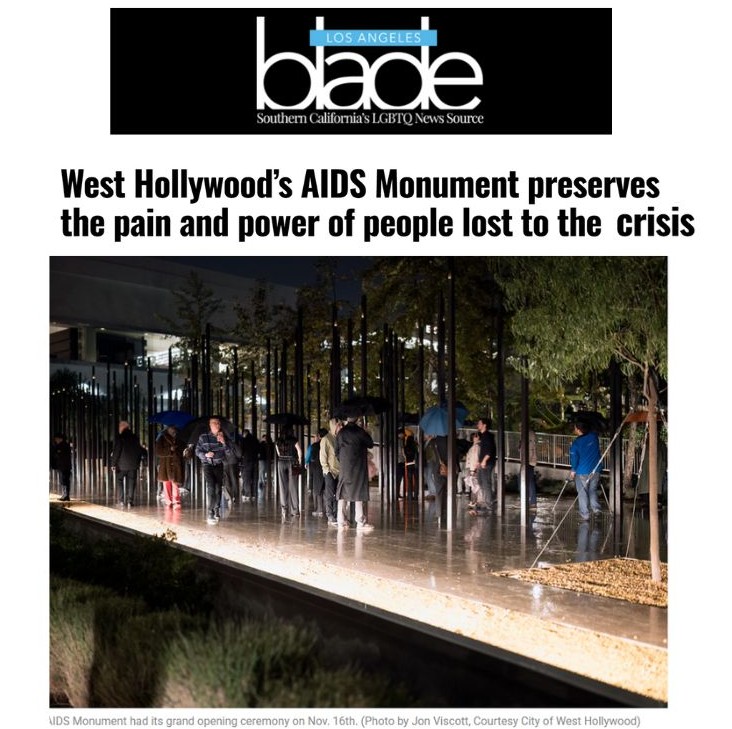
Created in collaboration with the City of West Hollywood, STORIES: The AIDS Monument is composed of 147 vertical bronze pillars known as “traces.” Designed by artist Daniel Tobin, 30 of these traces are engraved with words like: activism, isolation, compassion, and loss, which correlate to the over 125 audio stories collected and archived on the foundation’s website. This multimodal storytelling allows people who come across the monument to engage more intimately with the people represented by these physical pillars.
At nighttime, lights transform the monument into a candlelight vigil, providing a warm glow to a wanderer’s journey through the structure.
When people were able to walk around the traces at Sunday’s grand opening ceremony at the Pacific Design Center, the last remnants of the weekend’s rainstorm created a kind of “spiritual” and reverent atmosphere for those gathering, according to Rappaport.
“I think there’s a certain peacefulness and serenity about the design, an opportunity for reflection,” he continued. “For some, it may bring back incredibly painful memories. It might bring back wonderful times with friends who are no longer here. It might remind them of their own caregiving or activism, or the sense of community that they felt in striving with others to get more attention to the disease.”
Now that the monument has been built, FAM has passed the mantle of management and programming to One Institute, a nonprofit that engages community members with queer history through panels, screenings, and other educational initiatives. One Institute plans to host monthly docent tours, art installations, and other special events during various LGBTQ+ national awareness days, including the upcoming World AIDS Day in December.
Rappaport also hopes to do outreach with local schools, so that young students are able to engage with the monument, learn about the people who were affected by the AIDS crisis, and interact with the ripples of transformation that this time period sparked in politics, research, the arts, and within society.
“For younger people, I think [this is] an invitation for them to understand how they can organize about issues that they care about,” Rappaport said. “[So] they can see what the HIV and AIDS community did as a model for what they can do to organize and change the world, change culture, change law, change politics, change whatever they think needs to be changed. Because we had no other choice, right?”