Introduction
Sharon Stone: Welcome to STORIES: The AIDS Monument. I’m Sharon Stone, actress, painter, mom and longtime AIDS activist. This brief history will help you understand the devastating, lasting impact that HIV and AIDS had – and continues to have – on our nation. First, what is HIV and what is AIDS?
David Hardy: Hello, this is Dr. David Hardy, I have worked as an HIV doctor and researcher since the early 1980’s. Currently, I serve as an Adjunct Professor of Medicine at the Keck School of Medicine of USC, and a Board Member of the Foundation for the AIDS Monument. Human Immunodeficiency Virus, or HIV, is a virus that is transmitted from one person to another by sexual intercourse and through blood-to-blood contact including from mother-to-child during pregnancy and childbirth, by transfusion of blood products and by sharing needles and syringes when injecting drugs. HIV is engineered to attack the body’s immune system which protects us against life-threatening infections and cancers. Without treatment, HIV rapidly replicates and progressively destroys the immune system. The most advanced stage of HIV infection is called AIDS, which stands for Acquired Immune Deficiency Syndrome. Persons with AIDS can succumb to several opportunistic infections and cancers which take advantage of their severely suppressed immune systems. There is currently no cure for HIV available for most persons. Of note, however, as of 2025, HIV has been cured in 7 individuals who also had treatment-resistant cancers and underwent a highly risky stem cell transplant procedure to cure their cancer. Their HIV was cured as a side benefit of this procedure.
Sharon Stone: Once people get HIV, they have it for life. But with proper medical care, HIV can be well-controlled. People with HIV who receive effective treatment can live long, healthy lives and cannot spread the virus to others, including their sexual partners.
The first reported cases of the disease in the United States were in 1981, although subsequent studies have shown that AIDS or a closely related virus was present in the United States in 1968 and in the Belgian Congo in 1959. AIDS may have originated in Central or Western African villages as long ago as the late 1800s or early 1900 when it jumped from primates to humans. HIV and AIDS have disproportionately impacted Gay or bisexual men and people of color in the United States ever since it was first reported in 1981.
Wilson Cruz: I’m actor Wison Cruz. It is estimated that, as of 2025, over 700,000 Americans have died of AIDS, more than the number of Americans who died in World War I, World War II, the Korean War, the Vietnam War, and the Gulf War combined. But as horrifying as that statistic is, the scale of death has been and continues to be especially tragic for the LGBTQ population because of how concentrated HIV was and is among gay and bisexual men and trans women. Losing so many people in such a small segment of the overall population was like living through a war, one fought with few allies. The generation of gay and bisexual American men born between the mid-1940s and 1970 suffered especially devastating losses. By 1995, it is estimated that one out of every nine gay or bisexual men in the U.S. had been diagnosed with AIDS, and one in fifteen had died. Ten percent of the estimated 1.6 million gay or bisexual men aged 25-44 had died. Torie Osborn was Executive Director of the Los Angeles Gay & Lesbian Community Services Center from 1987 to 1993:
Torie Osborn: I was called to a hospital or a bedside every single day and I went to a funeral a week. I mean it was being in a war zone.
In the mid-1980s to mid-1990s if you walked down the street in the so-called “gay area” of a city like New York, Los Angeles, West Hollywood, San Francisco, Chicago, Atlanta, Houston, Dallas, Fort Lauderdale, Miami, Boston, or Seattle, you would often see men who were obviously sick. Young men struggling to walk down the sidewalk using canes, gaunt and weak. Men who should have been in the prime of their lives, yet their bodies were covered in dark purple lesions, or their eyes were blinded by disease. Many also suffered from dementia. During the height of the epidemic, the mid-80s to the mid-90s, gay men often had dozens, even hundreds, of friends who were HIV positive, or had died or were dying of AIDS. John Duran is a lawyer, former Board Co-Chair for Life AIDS Lobby, and was a member of the West Hollywood City Council for nearly 20 years.
John Duran: The first person I lost was Scott Fleener in June of 1985. He was one of 104 friends who would pass in a 10-year period. It is estimated that the greater West Hollywood neighborhoods and zip codes lost 10,000 people in that 10 year period. From 1990-95 all the residents in my 20-unit West Hollywood apartment building on Westbourne Drive died except for me and this elderly woman who had survived the Holocaust.
Wilson Cruz: Some people lost their entire circle of friends. Men in their 20s and 30s were writing wills and planning their funerals decades before people normally think about doing these things. Renowned painter David Hockney recalled that he lost 2/3 of his American friends to AIDS.
Sheryl Lee Ralph: I’m Sheryl Lee Ralph. AIDS took the lives of one-third of the original Broadway cast of “Dreamgirls.” I saw men in my New York neighborhood become ill and die within a few months. That’s why I created the DIVA Foundation (Divinely Inspired Victoriously Aware) which has given millions of dollars to organizations that raise awareness and provide services to people with HIV and AIDS. Although HIV and AIDS were beginning to spread into a wider array of communities, when they first became known to the public in the early 1980s, HIV and AIDS appeared primarily to affect those in groups known as the “Four Hs”: Homosexuals, Hemophiliacs, Haitians and users of Heroin or other injection drugs.
Reporter: A mystery disease known as the ‘gay plague’ has become an epidemic unprecedented in the history of American medicine. That today from the Center for Disease Control in Atlanta. Topping a list of likely victims are male homosexuals who have many partners and drug users who inject themselves with needles.
News clip from Fox 5 NY, “Early Coverage of AIDS Epidemic”
In the first two years we knew of the disease, we had no clue what caused it, how it spread, how to detect who had it, or how to treat it. In those years, an AIDS diagnosis was basically a death sentence. If they weren’t turning away those with AIDS, hospitals in major urban areas were overcrowded and overwhelmed. Here’s what I told an audience about my early experience when visiting friends in the hospital.
Sheryl Lee Ralph: When my friends doing “Dreamgirls” on Broadway literally just started dropping dead of a mysterious disease, it just changed everything about me. You would go to the hospital to see your friend and there was no hospital bed for them. You know, you would find them pushed out in the hallway, on one of those little gurneys with a sign that said: ‘do not touch’.
Hospital staffs were often afraid they would become infected if they treated those with AIDS. For over two years after the disease emerged in the U.S., we didn’t know that you couldn’t get HIV from casual contact.
Russell Thornhill: I’m the Reverend Elder Russell E. Thornhill of Unity Fellowship Church Movement Global Ministries and a university professor. I’m the past CEO of Minority AIDS Project and a retired pastor of Unity Fellowship of Christ Church. The public’s fear of contracting AIDS and dying exacerbated the stigma, discrimination and inequality already experienced by a wide range of communities who now had one more challenge to face, and a deadly one. Having a fatal disease is challenging enough in itself, but the situation was truly dire and overwhelming if you also had to face homophobia, racism, a lack of culturally competent services, or substandard medical care because you were a person with few financial resources. Question: what other disease can you think of that caused people to vilify its victims? Those who live with HIV or AIDS, or were suspected of having the disease, faced losing their housing, jobs, being rejected when applying for them. They faced losing their health insurance when they needed it most. Many were abandoned by their friends and families. They were turned away by doctors. Funeral homes refused to embalm or bury those who died of AIDS. They experienced the loss of their faith community where they grew up. Leaders of some white Evangelical Christian groups, who were a powerful political lobby starting in the Reagan era, called AIDS a punishment to gays for their sinful lifestyle.
Moderator: Reverend Falwell, you’ve called for the closing of bathhouses and other measures, and you say you’re calling for these measures to protect the health of the nation. But at the same time, you say that AIDS is God’s judgment on homosexual promiscuity.
Rev. Jerry Falwell: I believe that God does not judge people, God judges sin. And I do believe that AIDS generally caused and believed to be caused by homosexual promiscuity is a violation. Both of them are God’s laws, laws of nature and decency. And as a result, God who loves people, hates sin and deals, whether it’s a drug addict or an alcoholic or someone who is living promiscuously as far as his or her moral life is concerned. We pay the price when we violate the laws of God.
Jerry Falwell and Troy Perry debate the morality of AIDS in 1983 | CBC.ca.
According to the Pew Research Center, 60% of white Evangelicals in 1987 thought AIDS might be a punishment for immoral sexual behavior. Similarly, many Black church leaders ignored or demeaned those with HIV or AIDS and linked the disease with a sinful lifestyle and were thrown out of the church.
U.S. Surgeon General C. Everett Koop: In my old life as a surgeon in Philadelphia, when I had to deal with a problem, or I wanted to reach the Black Community, I went to the Black ministers, the Black clergymen, and they always responded. They got up in church next Sunday and said “This is what you have to do.” But I’ve talked to Black Clergymen in Boston, in New York, in Philadelphia during the AIDS epidemic and as soon as you get on these two behavior problems, IV Drug abuse and homosexuality, they look at their watch and say ‘I’ve got an appointment’.
Wayback News, https://www.youtube.com/watch?v=STyl16sQvVI
Mothers had to seek their own resources and could not go back to their churches for support. Family members likewise had to seek other resources in the community and they were not able to go back to receive the support that they needed even though they and their family members grew up in the church.
Wilson Cruz: Meanwhile, President Reagan never publicly mentioned the disease during the four years after the disease was first reported in the U.S. and killed at least 13,000 Americans. He only broke his silence in September 1985, shortly after his friend, film and TV leading man Rock Hudson, died of AIDS. Hudson’s death made headlines across the worldwide and humanized the disease for many in the public.
News Anchor: The death of Rock Hudson from AIDS, for many Americans it was the first time the disease and the stigma associated with it had been attached to a familiar face. And as more people become familiar with the disease, the fight against AIDS strengthened. An update from Sandy Kenyon.
Sandy Kenyon: Rock Hudson defined manhood for a generation. So the world was shocked when his beefy physique turned gaunt with disease. Shocked to learn his disease was AIDS.
CNN news report, https://www.youtube.com/watch?v=hBqFuA4bqPM
During the same period, the U.S. Supreme Court upheld a law used to prosecute a gay couple for having consensual sex in the privacy of their home. Violence against gays and lesbians and immigrants was on the rise. Backlashes against equal rights for women and minorities and affirmative action gained momentum. These were challenging times, to say the least, to be queer, a person of color, a woman, or an immigrant, in America.
Maria Roman: Those challenges have returned in full force today. I am Maria Roman, Chief Operations Officer and Vice President of the TransLatin@ Coalition. I’m also a former member of the LA County HIV Commission. Under the Trump Administration and in many states, we are experiencing attacks on Trans Americans, immigrants, women’s bodily autonomy, affirmative action and diversity initiatives. The Supreme Court’s decisions are elevating religious conservatives’ rights over the rights of LGBTQ Americans.
Rigo Garcia: In the 1980s, HIV and AIDS had a catastrophic impact on people with hemophilia or a bleeding disorder who required a blood-based product to stop bleeding. During that decade, HIV/AIDS also severely impacted people who received blood transfusions, babies born to mothers with HIV or AIDS who could contract HIV during pregnancy, childbirth or when breastfeeding, and those who used intravenous drugs and shared needles and syringes. I’m Rigo Garcia, Executive Director of the Hemophilia Foundation of Southern California. HIV-contaminated blood and blood products killed thousands who had no warning or protection against infection until a blood test to screen for HIV became available and, later, when a heat-treated blood plasma product was released for use by people with hemophilia or a bleeding disorder. One of those who died was Ryan White, a heterosexual teenager who contracted HIV from a blood transfusion in 1985 at age 13. Ryan was barred from attending his middle school because of fear of contamination. That expulsion became a national controversy and led to a TV movie about his story. Ryan became an AIDS activist and died in 1990 at age 18.
Dr. Don Francis, CDC official: And what happened was, IV drug users, people really at risk of AIDS, were selling their plasma. And the blood industry did not exclude gay men from blood donation, and so you ended up contaminating essentially all lots of factor 8 material that was used for, to treat hemophiliacs and infected essentially all of the hemophiliac population with a 100% fatal virus.
Clip from PBS Frontline, “The Age of AIDS, Part I,” https://www.youtube.com/watch?v=fS0OoreV-S4
Sharon Stone: When it became clear that the federal government lacked the will, the compassion, and the sense of urgency needed to meet the crisis, the LGBT community and others affected by AIDS had to mobilize and organize to raise money for AIDS research, education, and treatment. They had to take care of themselves with help from friends, from family members who hadn’t rejected them, and from some brave celebrity allies. In the early years of the epidemic, stars like Elizabeth Taylor, Joan Rivers, Bette Midler, Elton John, and Dionne Warwick helped raise money and awareness for AIDS charities at benefit performances.
Elizabeth Taylor: But here we are, coming together once again, to honor, to remember, to mourn our losses, and to pray, that maybe this year heaven can wait.
APLA Commitment to Life VII, https://www.youtube.com/watch?v=ga_vm_jczVo
Lesbians stepped up, among other things, caring for their gay brothers and running many LGBT organizations. In a handful of areas of the country, local governments provided funding and anti-discrimination laws, but for the most part it felt like no one in government was coming to the rescue. The LGBT community opened or expanded testing sites, dental clinics, meal delivery services, transportation services, housing support, counseling and, later on, clinics for medical treatment — all out of necessity because either none existed or those who ran them didn’t want to serve people with HIV or AIDS.
Sheryl Lee Ralph: Often, communities of color and the transgender community were not included in these efforts. Organizers in these communities found it much more challenging to raise the money necessary to provide these services. Donors were harder to find, and culturally entrenched homophobia and transphobia were an additional barrier to raising money and to creating targeted outreach programs.
Sherri Lewis: I’m Sherri Lewis. When I learned I was HIV positive in 1987, I didn’t know any other HIV positive women. Women confronted a public health system, pharmaceutical companies and doctors who didn’t focus on the threats to women from HIV and AIDS, and for years didn’t recognize the symptoms of the disease that were specific to women. As a result, many women went undiagnosed and couldn’t qualify for government benefits. After pressure from activists, in 1992, research, clinical trials and prevention programs finally addressed women’s issues.
As of 2022, nearly one out of every five people newly infected with HIV in the United States is a woman. About half of those women are Black, even though Black women are only about 13% of the U.S. female population. Too often we fail to realize and report on the impact that HIV/ AIDS has on women, the vast majority of whom are infected through heterosexual contact.
John Erickson: Facing scorn and neglect, AIDS activists tirelessly raised money from private donors and lobbied year after year for desperately-needed federal, state and local government funding for research, treatment, and education. I’m West Hollywood City Council member and former Mayor John Erickson. When the federal government was too squeamish or uncaring to talk frankly about sex and injection drug use, AIDS activists created their own safer sex and prevention campaigns. In 1985, its first year of cityhood, the City of West Hollywood sponsored one of the first government-funded AIDS awareness campaigns in the country, to talk directly to gay men about safe sex and prevention.
Abbe Land: I’m Abbe Land, former West Hollywood Mayor and City Council Member and a longtime LGBTQ ally. Confronted with friends and loved ones dying all around them, activists from groups like ACT UP marched in the streets, blocked traffic, took over federal buildings, and camped in front of hospitals.
ACT UP activists: “ACT UP, Fight BACK, fight AIDS!”
Reporter: Thousands of financial center workers leaving subways and hundreds more in cars with nowhere to go caught the performance, its message was blunt: spend more for research, treatment and education on AIDS.
ABC News, https://www.youtube.com/watch?v=tOoRthLrVg4
Activists grabbed media attention and successfully used the publicity to push the pharmaceutical industry, legislators and federal regulators to act more quickly to fund research and prevention campaigns, to approve drugs, and to lower the prices for AIDS medication.
Protestors: Your actions are killing us, your words are lies! 300,000 dead from AIDS
“Now This”: “Legendary: Peter Staley” https://www.youtube.com/watch?v=Eow4hcwoEjg
Lily Tomlin: Starting in 1983, films, TV shows, movies, mini-series and stage productions like St. Elsewhere, An Early Frost, Philadelphia, And the Band Played On, Angels in America, The Normal Heart and The Real World portrayed the terrible impact of AIDS on Americans, with a heightened compassion for the devastation facing the gay community.
President Clinton: Over the past few years, Pedro became a member of all of our families. Now, no one in America can say that they’ve never known someone that’s living with AIDS. The challenge to each of us is to do something about it, and continue Pedro’s fight.
A Tribute to Pedro Zamora” (MTV) https://www.youtube.com/watch?v=KBZDDqF-nvc
More recently, the TV series Pose dramatized the impact of AIDS on LGBTQ communities of color.
Michaela Jaé Rodriguez as Blanca Evangelista: Alright, I’m gonna tell y’all the hard truth. You boys are young, black, gay and poor. This world despises you. If you get this disease, you die. They feel relieved that you’re getting what you deserve, and living in a world like that can make you feel desperate for love.
“Pose”, Season 2, episode 2: https://www.youtube.com/watch?v=RKKWk72_-CQ
I’m actress and comedian Lily Tomlin. In the 1993 HBO movie And the Band Played On, I played an epidemiologist who tracked some of the earliest cases of AIDS. That role was particularly emotional for me because during the filming of the production I found out that a dear friend had been diagnosed with AIDS. The world lost so many talented artists to the disease, some of the biggest names in fashion design, music, dance, theater, film, television, and the visual arts. Prominent authors, journalists and sports figures succumbed to the disease. By the end of the decade, the TV movie The Ryan White Story dramatized the plight of hemophiliac teen Ryan White — who contracted HIV through a blood transfusion and was barred from attending his high school. Ryan’s story helped broaden people’s understanding of the virus. Then, in 1991, when Los Angeles Lakers superstar player Magic Johnson announced he was HIV positive, there was a major shift in the dialogue about HIV and AIDS.
Magic Johnson: Because I want people, young people, to realize that they can practice safe sex. Sometimes you’re a little naive about it, and you think it can never happen to you, you only think it can happen to other people. It has happened, and I’m gonna deal with it, and life will go on.
CNN, https://www.youtube.com/watch?v=VbdOQUARrEU
The public had proof that the heterosexual population was at risk, and that our nation’s AIDS prevention strategy had to engage a wider audience with more culturally diverse and multilingual messaging. We lived through nearly a decade of death, suffering and neglect under Presidents Ronald Reagan and George H.W. Bush. But in the early ‘90s, when the highest percentage increase in AIDS cases was among heterosexuals, President Clinton and a Democrat-majority Congress started to spend significant money and pass laws for AIDS research and prevention and to prohibit discrimination against people with AIDS.
David Hardy: On the medical front, it took nearly four years, from 1981 to 1985 to develop a blood test to determine who had HIV. Because of testing limitations and legal requirements for consent to do the test, you had to wait for as long as 2 weeks to receive your results for the first 10 years after the test became available. Until 1996, if you were at-risk for having HIV, you might have chosen not to take the test because there was no effective treatment available for you if you tested HIV positive. In addition, there were many potential threats to your job, your housing, your health insurance and other life necessities if your HIV status was made public. In 1996, medical researchers and pharmaceutical companies developed medications that could effectively treat HIV, changing it from a certain death sentence to a manageable illness. In those 15 years (from 1981 to 1996), almost 350,000 Americans died of AIDS. In 2012, another 16 years later, pre-exposure prophylaxis (or PrEP) became available to prevent acquiring the disease following sexual or shared IV drug exposure. The availability of PrEP has largely ended over three decades of fear of catching HIV for those at-risk who are able to obtain these medications. And now in 2025 options for PrEP can be given as infrequently as once every two months or even once every six months through long-acting injections. These medical breakthroughs have saved and continue to save millions of people in the U.S. and around the world who have health insurance or access to medications through a clinic or other program. Unfortunately, not everyone has benefitted from these medical discoveries due to the lack of awareness or access to them.
Phill Wilson: Hi, I’m Phill Wilson, founder and former President and CEO of the Black AIDS Institute, the former AIDS Coordinator for the City of Los Angeles, a former member of President Obama’s Advisory Council on HIV & AIDS, and a person living with AIDS.
The story of the HIV/AIDS pandemic is a tale of “two cities.” One white, wealthy, overwhelmingly gay. The other, people of color, female, people of trans experience, overwhelmingly poor, and sometimes, also gay. It is also a story of unimaginable medical, scientific, cultural, social, and political accomplishments – forged out of courage, persistence, resilience, and compassion.
The AIDS movement changed the way medicine is practiced, and research is conducted. We redefined the possible and built powerful previously non-existent institutions. We elevated the power and effectiveness of community activism and brought new meaning to the concept of “by the people, for the people”. Unfortunately, even with all our efforts, we were not able to bridge the gaps between the haves and the have-nots; or eliminate the structural and systemic construct where some of us matter and some of us don’t; some of us are seen and some of us are not; some of us are valuable and some of us are disposable. “Mind over matter” continues to be the prevailing ethos in the United States where “They don’t mind, and we don’t matter.”
Overall, the greatest beneficiaries of effective medical treatment and prevention for HIV and AIDS continue to be relatively affluent white gay men. Most of the HIV/AIDS institutions and health delivery systems were built by them, with them in mind. Even with the best of intentions, most of these institutions were and are ill-equipped to respond effectively to the needs of marginalized communities. Dr. David Ho’s discovery of Protease Inhibitors, and the so-called HIV drug cocktails were a game changer in the fight against HIV/AIDS. I was one of those many people who was able to get up off of my death bed after starting on the new therapies.
After 1996, effective treatment for those with HIV or AIDS was more widely available, yet the epidemic continued to grow in BIPOC, Women, and Trans communities. In some ways it felt like the AIDS pandemic was over for some communities. As donors began to prioritize other causes, AIDS was no longer the top priority for some LGBTQ+ organizations. Unfortunately, some pills that work for some of the people, some of the time, does not a cure make. With shifting priorities, many organizations serving BIPOC and other marginalized communities were left to fend for themselves. In 1998, two years after the availability of protease inhibitors, Black Americans represented 49% of AIDS deaths in the US. Half of Black Gay and Bisexual men in America were estimated to be living with HIV.
HIV and AIDS still rage in specific regions of the country, especially in Southern states and some rural areas, and among Transgender and other marginalized populations. Today, HIV infection and AIDS disproportionately impact Black, Latino and Transgender people compared to their percentage in the overall U.S. population.
Similarly, HIV and AIDS had, and continue to have, a greater impact on poor communities with less access to healthcare. Like many other diseases in America, AIDS strikes and persists in communities who suffer from social and economic disadvantages, from discrimination based on race, gender identity and sexuality, and from geographic disparities. We saw this play out with COVID-19 as well. Those of us who have the least power and money to influence our government and our healthcare systems remain the most at risk.
Mark S. King: What can we conclude looking back at the height of the HIV epidemic, and where are we today? I’m Mark S. King, an HIV survivor and the author of “My Fabulous Disease.” I tested positive in 1985, only weeks after the first HIV test became available to the public. Surviving the darkest years of AIDS was like surviving a war. So many died, including thousands who were lost just before life-saving drug treatments were approved in 1996. When those miraculous medications arrived, many people with AIDS who were seriously ill recovered – literally getting up from their deathbeds – experiencing what became known as “The Lazarus Syndrome.” But even survival has consequences. Many of us had left our jobs and careers behind. We had given up our housing or been forced out of it. We spent our savings and fell into debt because we simply had no long-term financial plans, much less a plan to live. We had to emotionally adjust to our renewed health, often with the guilt of having survived when so many others did not. We had to make new friends because so many of our friends had died. Today, survivors like me may carry emotional scars like anxiety, depression, and social isolation, but we are also the elders of a lost generation, and we’re still here. We claim our resilience, our power, our grief, and yes, we even claim the joy of being alive. We proudly serve as reminders of a story that must be told and that we must never forget.
Wilson Cruz: The AIDS epidemic has led to some unexpected benefits, however. LGBTQ Americans learned to organize and protect their own, to lobby the government, to raise huge sums of money, and to put pressure on businesses to get the results and change they need. Gay people realized that if they wanted public support to fight HIV and AIDS, they had to come out of the closet and make the general public realize that the disease was infecting or threatening their friends and loved ones. The LGBTQ community’s political and economic power, and its allies among major corporations and heterosexual voters, make it a force to be reckoned with. As of 2023, over 1,000 openly-LGBT candidates have been elected to political office at the local, state, and federal level. Marriage equality is the law of the land, and in 2020 the U.S. Supreme Court ruled that discrimination against LGBT people in employment is prohibited. But social changes trigger backlash. Attacks and attempts to deny benefits and equal treatment persist, especially for members of the Transgender community whose rights to bodily autonomy, gender-affirming healthcare, military service, and equal access to facilities, services and other rights are being taken away, denied or threatened.
President Trump: As of today, it will henceforth be the official policy of the United States Government that there are only two genders, male and female.
ABC News, https://www.youtube.com/watch?v=oEG-k2KSBxM
As the saying goes, “the price of liberty is eternal vigilance.”
Sharon Stone: Approximately 31,000-35,000 new cases of HIV infection are reported each year in the United States. An estimated 5,000 Americans die from AIDS each year. Globally, the World Health Organization estimates that, as of 2024, over 41 million people have died of AIDS, nearly 40 million people are living with HIV, and an estimated 630,000 died of HIV-related illnesses in 2022 alone. By far the largest proportion of HIV infections in the United States results from sexual contact between men. The New York Times reported that in 2017, America’s Black gay and bisexual male population had the highest rate of HIV of any nation in the world. According to the CDC, in 2022, an estimated 1.2 million Americans are living with HIV and 13% aren’t aware that they have it. Only two-thirds of those who are HIV-positive are receiving treatment. The vast majority of new infections — about 80% — were transmitted from people with HIV who either did not know they had HIV, or who received a diagnosis but were not receiving HIV care. The work of expanding testing, education, and access to healthcare and drug treatment continues, as does the search for a vaccine and widely-available cure.
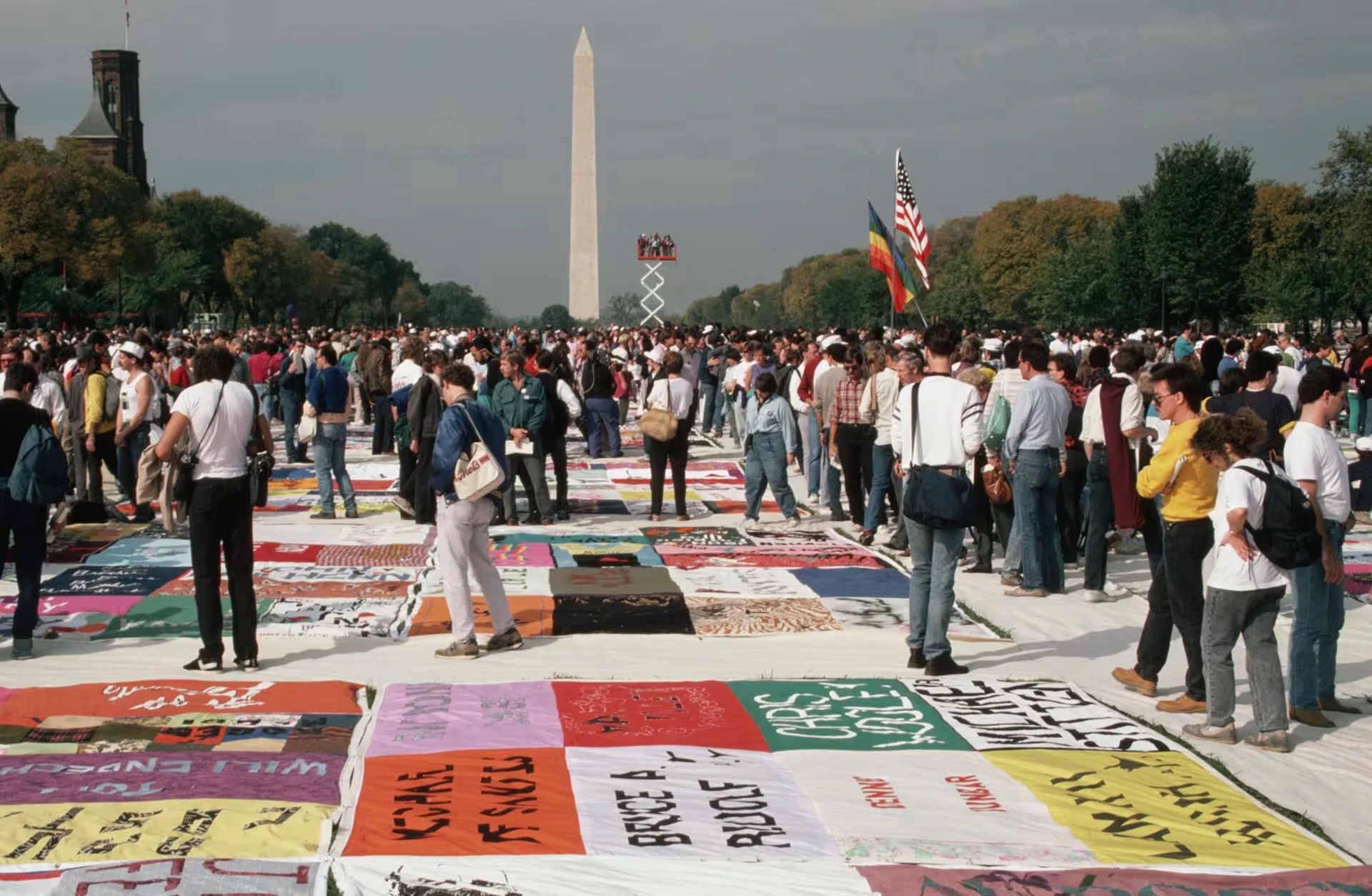
Irwin Rappaport: I’m Irwin Rappaport, Chair of the Board of the Foundation for The AIDS Monument from 2021 through 2025. Throughout the decades since AIDS first began to take the lives of our friends and loved ones, our nation has found ways to remember those we’ve lost and to celebrate the activists, caregivers, long-term survivors and community leaders who are crucial parts of the story of AIDS in America. The AIDS Memorial Quilt, which began in San Francisco in 1987, is a still-growing tribute comprised of tens of thousands of hand-sewn panels remembering those who are no longer with us. The AIDS Memorial page on Instagram contains thousands of tributes to those we lost to AIDS. AIDS memorials and monuments have opened in cities and towns across the country, including the National AIDS Memorial in San Francisco, the Wall Las Memorias in the Boyle Heights neighborhood of Los Angeles, the New York City AIDS Memorial, and the Seattle AIDS Memorial Pathway. We are deeply honored to add STORIES: The AIDS Monument in West Hollywood to this expanding collection of memorials and monuments.
We invite you to go to our website, aidsmonument.org where you can listen to some of the over 125 audio stories we’ve collected locally, from across the U.S. and abroad. Our website also has a library of videos, a detailed timeline, and links to helpful resources. Thank you for visiting STORIES: The AIDS Monument. We hope you enjoyed your time here, learned some valuable information, and will encourage your friends and family to pay us a visit. If you would like to hear more detailed information about the history of HIV and AIDS in the U.S., please listen to one or more of the following four chapters: Science & Medicine, Law & Policy, Activism & Organizing, and Culture & Society.
Written & Produced by: Irwin M. Rappaport
Edited by: David Neuendorff
Narrators (in order of appearance):
Sharon Stone
Dr. David Hardy
Wilson Cruz
Hon. John Duran
Sheryl Lee Ralph
Rev. Dr. Russell Thornhill
Maria Roman
Rigo Garcia
Sherri Lewis
Hon. John Erickson
Hon. Abbe Land
Lily Tomlin
Phill Wilson
Mark S. King
Irwin M. Rappaport
Archival Research: Karen Eyres
Consultants: Dr. David Hardy, Stephen Simon, Stephen Bennett, Phill Wilson, David Gere, Helene Schpak
© 2025, Foundation for The AIDS Monument. All right reserved.