Culture & Society
Dustin Lance Black: What was happening in American culture and society during the height of the epidemic from 1981-1996, and how did AIDS impact the culture and society? I’m Dustin Lance Black, LGBTQ rights activist and Oscar-winning screenwriter of Milk, as well as Rustin, When We Rise and Under the Banner of Heaven. Throughout the course of the epidemic, HIV & AIDS shined a spotlight on homophobia, racism, misogyny, and anti-immigrant attitudes shared by many Americans. The earliest days of the epidemic — the early to mid-1980s — were colored by the growing political power of evangelical Christians. Singer Anita Bryant opposed equal rights for gay people in employment and housing because
Anita Bryant: It’s an abomination to practice homosexuality.
RetroReport, PBS, https://www.youtube.com/watch?v=lorKkpqoJJU
Televangelist Pat Robertson and Rev. Jerry Falwell and his organization Moral Majority crusaded against gay rights. Religious leaders spouted hate instead of compassion for people with AIDS. Falwell said in June of 1983 that “AIDS is not just God’s punishment for homosexuals, it is God’s punishment for the society that tolerates homosexuals.” The growth of cable television eroded the control of the major TV networks over news and TV content in general and expanded the voices and venues for conservative Christians. Televangelist Tammy Faye Bakker caused an uproar in 1985 when she interviewed and showed compassion towards Reverend Steve Pieters, an openly gay pastor with AIDS, on her TV show on the PTL Christian Network. Public polling by the Los Angeles Times showed that most Americans in late 1985 favored quarantining people with AIDS. In the spring of 1986, leading conservative thinker William F. Buckley, founder of the magazine National Review, wrote in a New York Times op-ed that people diagnosed with HIV should be tattooed with a warning on their arm and buttocks. A few months later, the U.S. Supreme Court upheld a Georgia law criminalizing gay sex between consenting adults. In 1986, one in every five gay men and one in every 10 lesbians reported being physically assaulted because of their sexual orientation, according to an eight-city study of anti-gay violence conducted by the National Gay and Lesbian Task Force. In the fall of 1988, a New York Times/CBS poll showed that 75% of respondents had sympathy for people with AIDS, but when asked if that applied to someone who is gay, the sympathy dropped from 75% to 36%. It was a tough time to be gay in America.
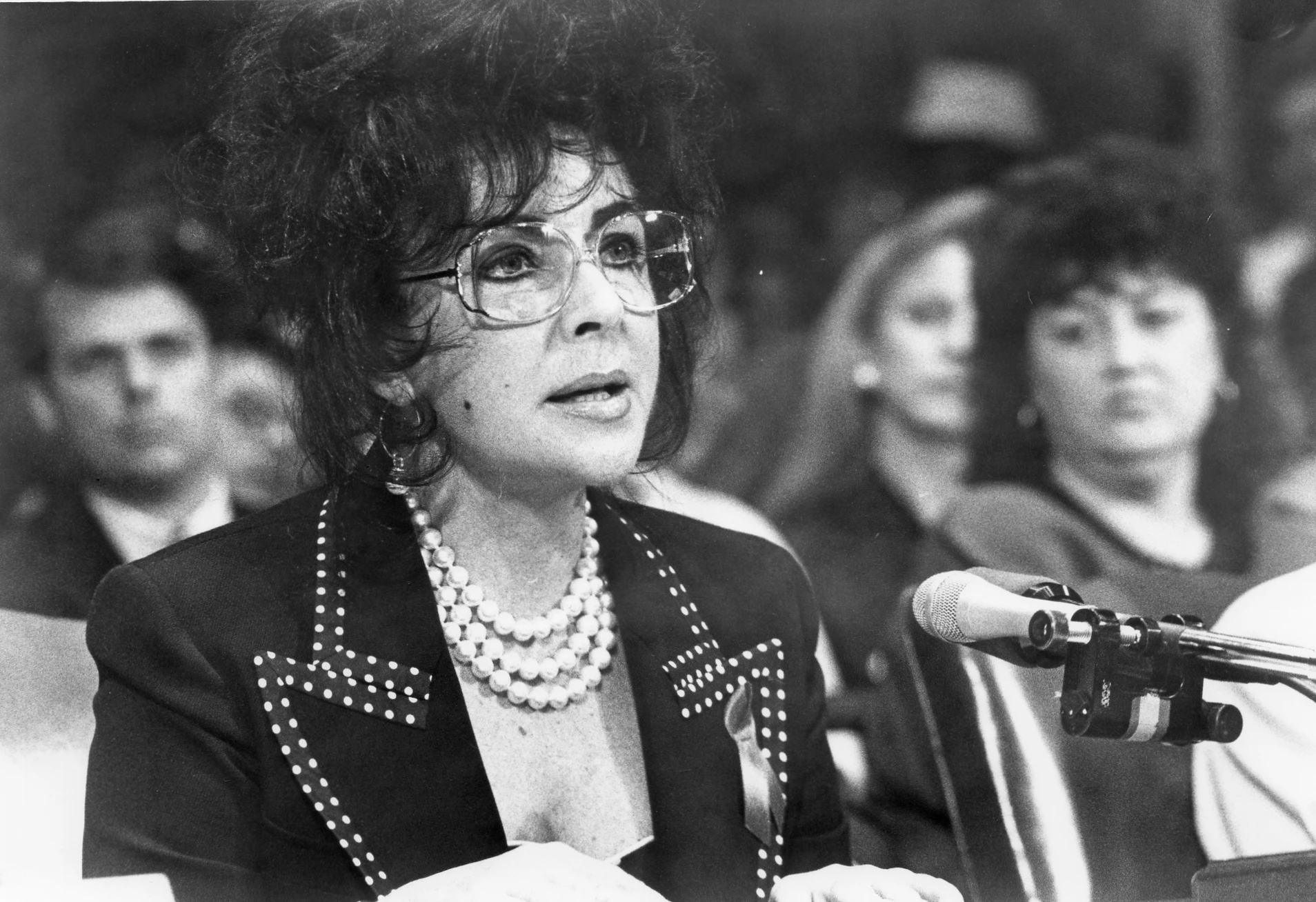
Bruce Vilanch: Bruce Vilanch here again. In this climate of prejudice, indifference and violence, AIDS activists often found it difficult to find prominent allies who could help raise money and expand awareness and empathy. Early public figures who braved the backlash included Elizabeth Taylor, Debbie Reynolds, Joan Rivers, Bette Midler, Princess Diana, Whoopi Goldberg, Cyndi Lauper, Shirley MacLaine, Rita Moreno, Judith Light, Nell Carter, Burt Reynolds, Liza Minelli, Zelda Rubenstein, Robert Guillaume, and Burt Lancaster. In early 1986, the song “That’s What Friends Are For,” recorded by Dionne Warwick, Stevie Wonder, Elton John and Gladys Knight, was #1 on the Billboard charts, and eventually raised about $3 million for the American Foundation for AIDS Research (or, amfAR). Sharon Stone succeeded Elizabeth Taylor as Global Campaign Chair for amfAR after Taylor’s death. Elton John founded the Elton John AIDS Foundation in 1993. Other celebrity allies included Madonna whose album “Like a Prayer” included safe sex information, as well as Cher, Sandra Bernhard, Bono, Susan Sarandon, Annie Lennox, Danny Glover, Yoko Ono, Robin Williams, Billy Crystal, Carol Burnett, Sammy Davis Jr., Rod Stewart, and Diahann Carroll. Music industry mogul David Geffen came out as gay at a 1992 APLA Commitment to Life dinner and was a generous donor to AIDS charities in Los Angeles and New York City.
Matt Bomer: It’s Matt Bomer again. News about AIDS didn’t make the front page of the New York Times until May 1983. But through magazines like POZ, which was first published by Sean Strub in 1994, and The Body which debuted in 1995, the AIDS community found its own way to communicate about the epidemic, not only with developments in treatment and policy but also showcasing the experiences and perspectives of people with HIV or AIDS.
AIDS stories began to appear in film, television, and theater. In December 1983, we saw the first character on television with AIDS in an episode of the medical drama St. Elsewhere. The NBC TV movie An Early Frost, broadcast in 1985, was the first major motion picture on television about AIDS. It reached an audience of 34 million people, was nominated for 11 Emmy awards and won three.
Terry O’Quinn as Dr. Redding: You can’t get AIDS just by being around someone who has it, that it’s only transmissible through intimate sexual contact or blood.
Aidan Quinn as Michael Pierson: Then how did I get it?
“An Early Frost” (NBC), https://www.youtube.com/watch?v=RH3VhtUgOk8
In the same year of 1985, the first AIDS-related plays were produced, including the Off-Broadway play The Normal Heart, by Larry Kramer at New York’s Public Theater, and the Broadway production of As Is, by William M. Hoffman. The Normal Heart astounded critics and audiences alike with its fierce passion, while Hoffman’s As Is won that year’s Tony Award for Best Play.
Joe Mantello as Ned Weeks: I’m beginning to think that you and your straight world are our enemy…I’m furious with you…and with myself, and with every goddamn doctor who ever told me I’m sick and interfered with my loving a man. I’m just, I’m trying to understand why nobody wants to hear that we’re dying.
2011 stage production of “The Normal Heart”, https://youtu.be/Aa3luI1ythI
Later, in 1993, Tony Kushner’s play about AIDS, Angels in America won 4 Tony Awards and a Pulitzer Prize, as well as 11 Emmy awards when adapted for television. Philadelphia, starring Tom Hanks and Denzel Washington, was released in late 1993 and was the first major theatrical release of a film about AIDS.
Denzel Washington as Joe Miller: Alright explain this to me like I’m a two year old, OK, because there’s an element to this thing that I can’t get through my thick head. Didn’t you have an obligation to tell your employer that you had this dreaded, deadly infectious disease?
Tom Hanks as Andrew Beckett: That’s not the point. From the day they hired me to the day I was fired, I served my clients consistently, thoroughly, with absolute excellence. If they hadn’t fired me, that’s what I’d be doing today.
Clip from “Philadelphia” (TriStar), https://youtu.be/wHSH-NpCQOw
The Real World brought AIDS into America’s living rooms as they got to know and love young Latino AIDS activist Pedro Zamora until he died in 1994. Since 1983, dozens of movies and TV shows with major HIV/AIDS storylines, or actors playing characters with HIV/AIDS, have been released in the U.S. and have won at least 13 Academy Awards and 20 Emmy Awards. These productions spoke to the experiences of those living with HIV or AIDS and their friends and families and gave others a window into such experiences.
In July 1985, film and TV leading man Rock Hudson publicly announced that he had AIDS and traveled to Paris for experimental treatment. His announcement, the first for any major public figure in the U.S., made headlines around the world.
Dr. Mathilde Krim: I think his case has brought many people in this country to realize that people who are beloved, who are wealthy, who can afford the best medical care in the world, nevertheless they can die of it.
WABC-7 Eyewitness News (New York) with Roger Grimsby, https://www.youtube.com/watch?v=w8g_Xzk99pU
For many in the public, Rock Hudson was the first recognizable person with the disease. Hudson died of AIDS only three months later.
Judith Light: Ryan White was a hemophiliac who contracted HIV from a blood transfusion at age 13. I’m Judith Light, HIV and AIDS advocate, and I played Ryan White’s mother Jeanne in the 1989 movie The Ryan White Story. Ryan was barred from attending his middle school. His story and the fear and ignorance that led to his expulsion from that school and the legal battle to allow him back into school became a national controversy and the subject of that 1989 TV movie. That movie drew 15 million viewers. Ryan became an outspoken advocate for AIDS, for research and public education. He died of AIDS-related complications in 1990 at the age of 18.
Tony Valenzuela: I’m Tony Valenzuela, Executive Director of One Institute and former Executive Director of Lambda Literary. In the worlds of painting, photography, theater, and literature, artists and writers produced works that conveyed personal and societal reactions to the HIV/AIDS epidemic, documenting and interpreting the impact of the disease on their lives, and the lives of their loved ones.
In 1989, the organization Visual AIDS conceived of a “Day Without Art” on World AIDS Day, December 1st, to bring attention to the AIDS crisis, to mourn those lost to the disease, and to educate the public. Some museums and galleries covered their art with information about HIV and safer sex; others closed their doors, dimmed their lights, or produced special exhibitions or performances. In its first year, 800 organizations, galleries and museums participated. By the mid-1990s, over 8,000 participated.
Los Angeles author Paul Monette’s 1988 memoir, Borrowed Time, chronicled with pain and tenderness the illness and death from AIDS of his longtime partner, Roger Horwitz. Nominated for a National Book Critics’ Circle Award, it was the first major American book to humanize the AIDS epidemic and an important response to the public scorn, fear, and shame felt by those with HIV/AIDS in society at the time. “Grief is a sword, or it is nothing,” wrote Monette, helping to pierce American consciousness into understanding the devastation of the disease on a mass scale.
Greg Louganis: Given the fear and stigma associated with AIDS, it’s no wonder that people, famous or not, were afraid to get tested and to admit to being HIV positive or having AIDS. I’m Greg Louganis. I won four Olympic gold medals as a diver for the U.S. in 1984 and 1988. In 1995, I came out as gay and disclosed that I had been living with HIV for seven years.
Freddie Mercury, lead singer of the legendary rock band, Queen, was rumored to have AIDS as far back as 1985. Queen stopped performing in public in 1986 and Freddie learned he had AIDS in 1987, but he only publicly announced it in late November of 1991. Freddie died the next day.
The gay community had and still has its own issues with how HIV-positive people are treated by their gay brothers. People with visible signs of AIDS, like the purple-black blotches of KS or a severe loss of weight and muscle, were scorned and felt ashamed to be seen in public.
Richard Phibbs: Baker Wilkins was my best pal from our 20’s into our 30’s. We met for lunch one day, and he revealed to me he had tested positive. Then the KS began to take over Baker’s body. He tried to live his life as normally as he could. He even went out to Fire Island. But when his skinny, KS, purple body entered the pool, everyone else got out. My heart broke again.
Even today, as medication can reduce one’s viral load to an undetectable level, and science tells us that the virus isn’t transmissible from a person whose viral load is undetectable, there is prejudice against and fear of having sex with or dating HIV-positive people.
Mark Malkin: I’m Mark Malkin, Senior Culture and Events Editor at Variety, and a man living with HIV. AIDS decimated artistic and creative industries and communities. We lost so many great talents and can only imagine what beautiful and provocative work they may have created if they had survived. AIDS also took the lives of famous figures in sports. It is inevitable that any list of deaths of well-known people from AIDS will leave out significant names, but here are some memorable losses: actors Rock Hudson, Anthony Perkins, Robert Reed, Amanda Blake, Howard Rollins, Michael Jeter, and Brad Davis; reality TV stars Pedro Zamora and Lance Loud; film directors Tony Richardson, Marlon Riggs and Emile Ardolino; fashion designers Halston, Perry Ellis, Willi Smith and Patrick Kelly; tennis legend Arthur Ashe; all-pro NFL football player Jerry Smith; Major League Baseball player Glenn Burke; ice skating Olympic and world champion John Curry; supermodel Gia Carangi; artists Keith Haring, Robert Mapplethorpe, Felix Gonzalez-Torres and Steven Arnold; Broadway choreographer, director and writer Michael Bennett; choreographer Alvin Ailey; playwright Nicholas Dante; ballet star Rudolf Nureyev; science fiction writer Isaac Asimov; musicians Freddie Mercury, Jacques Morali of the Village People, Eazy-E, Tom Fogerty of Creedence Clearwater Revival, Ricky Wilson of the B-52s, Liberace, Sylvester, and Jermaine Stewart; lyricist Howard Ashman; songwriter Paul Jabara; news anchor and journalist Max Robinson; author and journalist Randy Shilts; French philosopher Michel Foucault; author Paul Monette; and photographer and video director Herb Ritts.
Sherri Lewis: As the years passed, the American public was forced to confront more high-profile cases of HIV and AIDS among heterosexuals. I’m Sherri Lewis, a Board member of the Foundation for The AIDS Monument and a straight woman living with HIV since 1987. In May 1990, the CDC reported that the highest percentage increase in AIDS cases was from heterosexual sex. On November 7, 1991, Los Angeles Lakers superstar Magic Johnson announced that he was HIV-positive.
Peter Jennings: Magic Johnson confirmed today that he has the AIDS virus. He becomes a statistic.
Magic Johnson: Because of, umm, the HIV virus that I have attained, I will have to retire from the Lakers today.
Dan Rather: The dazzling career of one of the world’s best known athletes is over.
“ABC World News Tonight” with Peter Jennings & “CBS Evening News with Dan Rather”, part of “Magic Johnson: The Announcement” on NBA YouTube channel, https://www.youtube.com/watch?v=xMMWLS8D4OU
Suddenly, the media were abuzz with “heterosexual AIDS.” While Black and Latina women and their children had been swept up in the AIDS epidemic from the very beginning, the general population, especially straight White people, were finally realizing that HIV doesn’t discriminate by race, ethnicity, gender, or sexual orientation.
Dustin Lance Black: With so many dead and dying, the country needed ways to grieve and remember those we lost. In June 1987, a group of gay rights activists in San Francisco created the AIDS Memorial Quilt. Those who had lost loved ones or wanted to pay tribute to someone who died of AIDS could make and submit a handmade quilt panel measuring 3 feet by 6 feet, approximately the size of a grave, with a name stitched into it. Panels often included a photo or other likenesses of the person who died, along with memorabilia from their life. The first public display of the Quilt in 1987, on the National Mall in Washington D.C., included 1,920 panels dedicated to people who had died of AIDS. Half a million people visited that display. When the Quilt was displayed there again in 1996, it had grown so large that it covered the entire National Mall, stretching over two miles from the Lincoln Memorial to the U.S. Capitol. President Clinton, First Lady Hilary Clinton, Vice President Gore, and his wife Tipper joined approximately 1.2 million visitors to the Quilt. The AIDS Memorial Quilt is the largest community arts project in U.S. history and is now housed in San Francisco under the care of the National AIDS Memorial in Golden Gate Park which was designated as a federal memorial in 1996. More recently, the popular AIDS Memorial page on Instagram offers thousands of stories of people we lost to AIDS, accompanied by photos and videos. It features the hashtag, “What is Remembered Lives.”
Irwin Rappaport: Over 40 years of pain and perseverance, medical breakthroughs, activism and organizing inspired us to create STORIES: The AIDS Monument. I’m Irwin Rappaport, Board Chair from 2021-2025. Our mission is: to Remember those we lost, those who survived, the protests and vigils, and the caregivers; to Celebrate those who step up when others step away; and to Educate future generations through lessons learned. Thank you for listening.
Written & Produced by: Irwin M. Rappaport
Edited by: David Neuendorff
Narrators (in order of appearance):
Dustin Lance Black
Bruce Vilanch
Matt Bomer
Judith Light
Tony Valenzuela
Greg Louganis
Mark Malkin
Sherri Lewis
Irwin M. Rappaport
Archival Research: Karen Eyres
Consultants: Dr. David Hardy, Stephen Simon, Stephen Bennett, Phill Wilson, David Gere, Helene Schpak
© 2025, Foundation for The AIDS Monument. All right reserved.