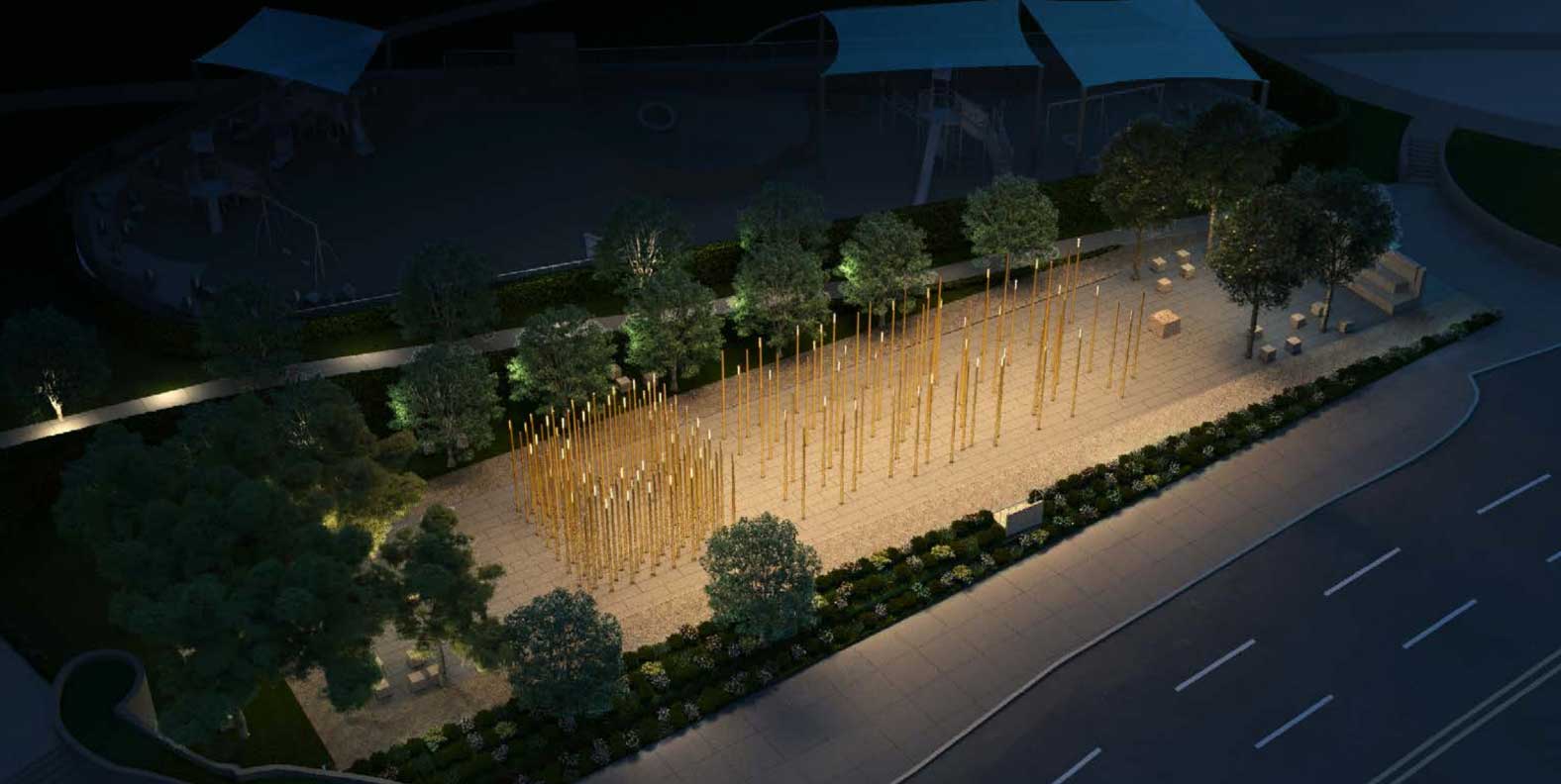
Design Tour of the Monument
Rogerio Carvalheiro: My name is Rogerio Carvalheiro. I was the Chair of the Design Committee for STORIES: The AIDS Monument. What follows is a brief design tour of the Monument.
The Monument was designed by Australian artist Dan Tobin. Here is a statement from Dan about his inspiration and hopes for the Monument.
Dan Tobin: Although I was a teenager in the early years of the AIDS epidemic and became HIV+ later, my understanding of the AIDS crisis was still somewhat limited. I was humbled to hear first-hand the heart-wrenching stories of loss, stigma and fear, alongside hopeful stories of compassion, caregiving and strength in the West Hollywood community. These stories animated my design. My hope is that this will be a sacred place of remembrance to hold these and more stories through the ages, inspiring future activism and greater appreciation for our common humanity.
We begin our tour in the arrival plaza. When facing the long stone wall, you will see the name of the monument and our mission statement on the left. We chose the name STORIES: The AIDS Monument because telling the stories of people, and of the organizations that were born during the height of the epidemic, is the best way we know how to fulfill that mission.
On the right side of the wall is acknowledgement of our major donors who contributed $25,000 or more. Those whose names appear at the top, in larger text, donated $100,000 or more. Below the names of the major donors is a recounting of the staggering loss of life experienced in West Hollywood and nationwide.
As you walk around the long stone wall, you first encounter a stone pedestal with a short summary of major milestones in AIDS history.
Behind you, above the bleacher seating, you will find quotations from activists Connie Norman and Elizabeth Glaser.
After reading those quotations, continue walking south toward the tall bronze pillars. The Monument contains over 12 dozen of these 13-foot bronze pillars which we call “Traces”, suggesting the traces left behind by those we lost to AIDS or those who marched in candlelight vigils. The Traces lightly touch the ground and pierce the sky. There is a variable, organic quality to the patina and texture of the bronze surface. Each Trace has a slightly different color with intentional imperfections. In that way, like a person, each Trace is unique, although the shape of each Trace is consistent.
The organization of the Traces in the Monument is a metaphor for what those affected by HIV and AIDS experienced in the early-to-mid 1980s, and the different experience from the mid-1980s until the mid-1990s. An engraved narrative tablet at the beginning of the field of Traces describes those different experiences.
The Traces start with an informal, unstructured layout. This layout conveys the devastating loss, fear, confusion and isolation of the early years, roughly 1981-1985, when we didn’t know what caused AIDS and before testing for HIV became available. In the early years, the public didn’t really understand the disease, what caused it, how was it spread, how we were going to treat and cure it, how we were going to care for the sick, or when the fear, death and confusion were going to end.
As you move beyond the Traces in this section and toward the end of the Monument, the layout of the Traces is more defined, structured and cohesive. This corresponds to the period in the mid-1980s when we entered an era of community organizing, activism and anti-discrimination laws, until 1996 when medication to prevent the disease became available. As we fought for civil rights, organized, cared for the sick, and educated the public about prevention, as effective medical treatment became available, the disease became more manageable and understandable. The organization of the Traces into a grid reflects that greater clarity, healing and feeling of community.
The Monument offers a different experience depending on whether you visit during the day or at night. As the sun sets, the lights at the top of Traces are gradually illuminated, resembling the candlelight vigils that gave marchers a way to pay their respects to their fallen friends and loved ones and find a sense of support and community during a very difficult time.
As you walk through the Traces, look up and you will notice that some Traces are engraved just above eye level. 30 of the Traces have words engraved on them, words representing what people were and still are feeling and experiencing in connection with HIV and AIDS. Each word represents a category of audio stories you can listen to. If you go to the same menu where you selected the design tour, you’ll see an option called “Hear Our STORIES.” If you click on that option, it brings you to a Word Wall from which you can select one of the 30 words engraved on the Traces. If you want to hear stories about Loss, click on that word and you’ll see a variety of stories on that theme. If you want stories about Community, click on that word, and so on.
In the center of the grid of Traces, you’ll find two bronze plaques engraved with quotations from poets Gil Cuadros and Essex Hemphill.
As you exit the grid of Traces and enter the area at the end of the Monument surrounded by Australian willows, you’ll find a final narrative stone tablet with a quotation from author Paul Monette who reminds us of the challenges still facing us as we deal with HIV and AIDS today. You may wish to sit under the Willow trees and reflect on your experience. Perhaps listen to some audio stories from the Word Wall, or go back to the menu on your phone and listen to the Brief History of HIV and AIDS. Or maybe share your thoughts and memories with another visitor at the Monument.
As you turn back towards where you started, walk along San Vicente Boulevard across from the red, green and blue buildings of the Pacific Design Center. You’ll notice a podium at the edge of the Monument looking out at the street and the sidewalk. This podium allows the Monument to be a place where we continue the activism we saw during the AIDS crisis, a stage for protests, celebrations and community events that bring people together in both difficult and happy moments. After exiting the Monument, and when facing the podium from the sidewalk, you’ll find the iconic rallying cry of the activist group ACT UP: “Silence Equals Death, Action Equals Life.”
Thank you for visiting STORIES: The AIDS Monument. We hope you’ll visit again and invite your friends, family and colleagues to experience the Monument.
Narrators (in order of appearance):
Rogerio Carvalheiro
Dan Tobin