Activism & Organizing
Sharon Stone: I’m Sharon Stone, and after my friend Elizabeth Taylor passed away, I served as Global Campaign Chair of amfAR from 1995-2020 to raise awareness and millions of dollars in funding for AIDS research. When the communities affected by HIV and AIDS saw the lack of meaningful governmental response and the glacial pace of drug trials and approvals, they realized no one was coming to their rescue. They had to organize, fight back and take care of themselves.
Protesters chanting: Healthcare is a right, healthcare is a right! Boycott, Boycott, Boycott
ABC7-TV coverage of ACT UP protest, clip from “Inside Edition”: “How ACT UP Flipped the Script on Gay Rights and AIDS”, https://www.youtube.com/watch?v=Y3rH8q9Q-mQ
Within a year after the CDC’s first report about the disease, AIDS services organizations opened in major U.S. cities to provide direct services, counseling, education, and testing. Let’s remember that this was happening before the public used email, texting, and the Internet. Those tools didn’t become widespread until the mid-1990s. So, activists and organizations got the word out through newspaper and magazine ads, the U.S. mail, word of mouth, passing around pamphlets and flyers or posting them on community bulletin boards or in shop windows, and using hotlines and phone banks.
Phil Curtis: I’m Phil Curtis, Director of Government Affairs at APLA Health, which began as AIDS Project Los Angeles in the early 1980s. Gay Men’s Health Crisis in New York City was the nation’s first community AIDS organization in 1982, and soon thereafter AIDS services organizations opened in San Francisco and Los Angeles. The Los Angeles Gay & Lesbian Community Services Center (now called the L.A. LGBT Center) provided AIDS-related services, including testing starting in 1985 along with anti-discrimination legal services, counseling, and youth services. AIDS Project Los Angeles (or, APLA) was born from a meeting at the Gay & Lesbian Community Services Center where advocates sought to broaden the scope of community services. I’ve worked at APLA Health since 1989, longer than any other employee. APLA grew from basically a volunteer hotline in 1982 to include the largest HIV food bank in the nation, a dental clinic for People Living with HIV, case management, benefits counseling, a home health program, behavioral health counseling, support groups, and more. In 1983, LA Shanti was founded to provide direct services, emotional support groups and death with dignity for people with AIDS in Southern California, especially LGBT people and minority groups from socioeconomically disadvantaged backgrounds. Six of the country’s largest AIDS organizations united in 1984 to form and help fund AIDS Action Council, a national advocacy group which lobbied federal, state, and local governments on healthcare, prevention, research and housing, and helped achieve Congressional passage of the Ryan White CARE Act.
In May 1983, APLA held the first AIDS candlelight march in Los Angeles at the Federal Building in Westwood. Five thousand people marched to raise awareness and to press for more government funding. Similar marches were held in New York City, San Francisco, Boston, Chicago, Dallas, and Houston.
Protesters chanting: Act Up! Fight back! Fight AIDS! Act Up! Fight back! Fight AIDS! Act Up! Fight back! Fight AIDS!
ABC7-TV coverage of ACT UP protest, clip from “Inside Edition”: “How ACT UP Flipped the Script on Gay Rights and AIDS”, https://www.youtube.com/watch?v=Y3rH8q9Q-mQ
Tens of thousands of people filled the streets in these cities, and candlelight marches became an important visual symbol of the fight against AIDS. AIDS/Life Cycle, a 7-day 545-mile bike ride, began in 1994 as the California AIDS Ride and since then has raised hundreds of millions of dollars to benefit HIV and AIDS services at the San Francisco AIDS Foundation and the Los Angeles LGBT Center. In late July 1985, APLA held the first annual AIDS Walk Los Angeles, raising $673,000 from more than 4,500 walkers. In September of that year, two months after her close friend Rock Hudson revealed that he had AIDS, actress Elizabeth Taylor hosted the first APLA Commitment to Life dinner. It raised $1.3 million for patient care. Taylor also co-founded the American Foundation for AIDS Research and later founded the Elizabeth Taylor AIDS Foundation.
Torie Osborn: I’m Torie Osborn, former CEO of the Los Angeles LGBT Center. During the AIDS epidemic, we lesbians dove into caring for our gay brothers. Many lesbian nurses worked on AIDS hospital wards and we organized blood drives and visited AIDS patients. We also brought our organizing skills and leadership to our LGBT and AIDS services organizations while our gay brothers were fighting just to stay alive.
Matt Bomer: I’m actor Matt Bomer. One of the roles I’m most proud of is my Golden Globe winning role in the HBO movie adaptation of Larry Kramer’s The Normal Heart. In 1982, although we didn’t yet know what caused AIDS or how to treat it, activists realized that they had to educate the public about the importance of using condoms and other advice for safer sex. The medical profession and public health officials failed to provide guidance and, let’s face it, people were still going to have sex. Thinking otherwise was just plain naïve and bad public health policy. The HIV/AIDS community took the reins, educating itself on treatment updates via publications such as AIDS Treatment News which began in April 1986.
FDA-approved drugs like AZT eventually proved ineffective and often toxic. The drug approval process was too slow for patients who were on death’s doorstep. The FDA allowed some experimental drugs to be imported in small quantities to treat people with AIDS, but they weren’t enough. So, an underground network of illegal buyers’ clubs, like the one portrayed in the 2013 movie Dallas Buyers Club, popped up across the country to import and distribute those experimental drugs.
Hank Stratton: It’s Hank Stratton again. In the mid-1980s, other local organizations sprung up in the L.A. area and expanded their services to include AIDS, including those whose mission was to reach and serve minority populations. They got to work raising money and offering education and outreach, testing, counseling, treatment, research and patient care. Rev. Carl Bean and Jewel Thais-Williams co-founded the Minority AIDS Project in 1985. It was the first community-based HIV/AIDS organization established and managed by people of color. Being Alive opened in 1986 “to bring people living with HIV/AIDs out of seclusion and into a supportive, self-empowering community” and demanded “competent, fair, and respectful medical treatment.” Cara-a-Cara, a grassroots educational outreach for Latinos, started in 1987. Bienestar, founded by Oscar de la O, established six community health centers for the Latino population starting in 1989. Asian Pacific AIDS Intervention Team opened in 1987 to do community outreach about AIDS to the Asian Pacific Islander community. Starting in 1989, Marianne Williamson founded Project Angel Food which delivered meals to home-bound patients, and still does so. The Black AIDS Institute was formed by Phill Wilson in 1989 with a mission to stop the AIDS epidemic in Black communities by engaging Black leaders, institutions, and individuals. The same year, Jewel and Rue Thais-Williams opened Rue’s House, the first facility in the country offering housing for women with AIDS and their children. Legal services organizations like Lambda Legal and local governments like the Los Angeles City Attorney’s Office opened HIV/AIDS-specific programs to file discrimination lawsuits against employers, housing providers, healthcare providers and others. Private lawyers and non-profit agencies helped clients with AIDS deal with wills, powers of attorney and family law issues.
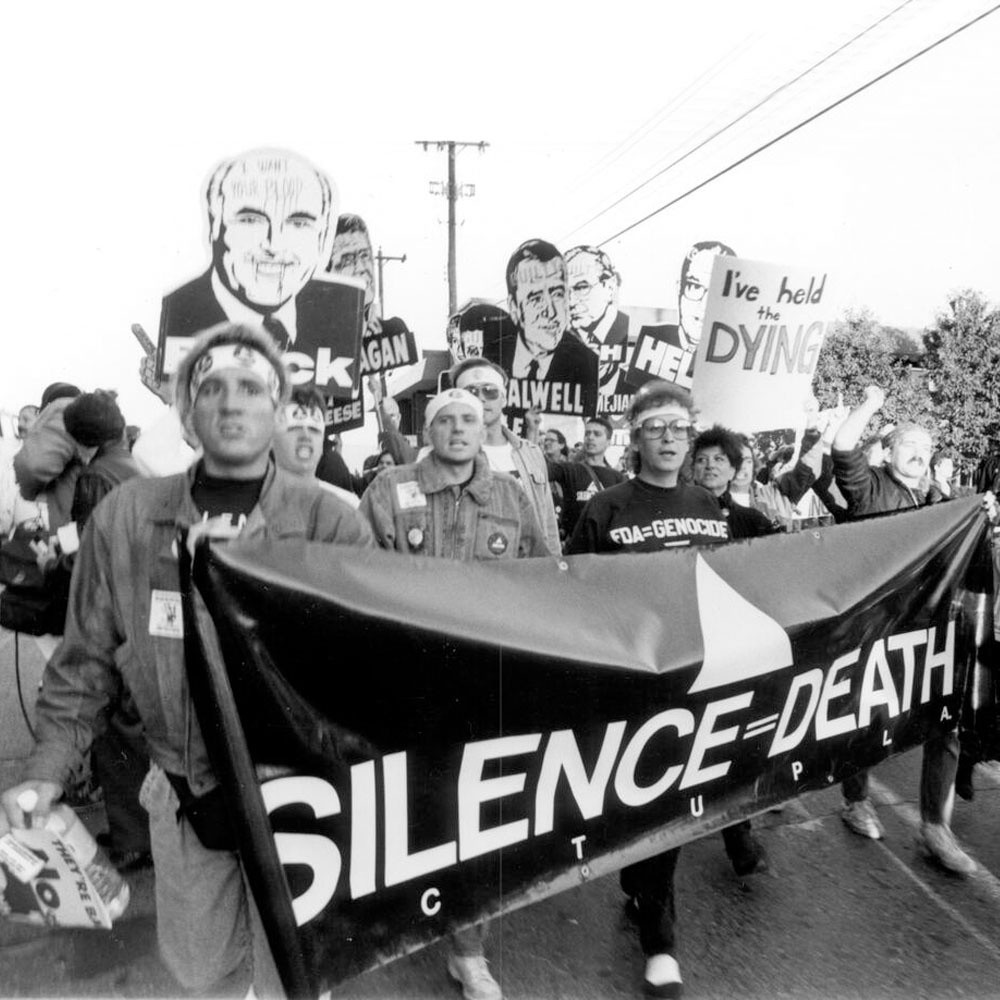
Helene Schpak: Probably the best-known AIDS activist organization is ACT UP, which stands for the AIDS Coalition to Unleash Power. I’m Helene Schpak, one of the producers on the ACT UP/LA Oral History Project and an early member of ACT UP/LA.
Larry Kramer, who for years had been publishing urgent articles and making angry pleas for community activism in the face of government inaction and institutional homophobia, founded ACT UP in 1987 in New York City.
Larry Kramer: Plague! 40 million people infected is a fucking plague. And nobody acts as if it is. Nobody here either. Nobody in this hospital, nobody in this city, nobody in this world!
Kramer’s 1991 speech, in “Now This Impact”, https://www.youtube.com/watch?v=mocXSBxaPK4&t=6s
Using non-violent civil disobedience, political advocacy, eye-catching visuals, and clever slogans on posters and protest signs, ACT UP had a knack for getting media attention to radically change the response to AIDS from the government and the pharmaceutical and healthcare industries. Following the October 1987 March on Washington for Gay and Lesbian Rights, Mark Kostopolous and several others were inspired to found the second ACT UP chapter here in Los Angeles. Soon additional ACT UP chapters sprang up throughout the US including, San Francisco, Chicago, Philadelphia and then around the world including London, Sydney, Paris. The national coalition of these cities working together led Time magazine to call ACT UP “the most effective health activist [group] in history.”
ACT UP activists continued to stage ever-more-dramatic operations to draw national media attention toward AIDS. In December 1989, they disrupted services at St. Patrick’s Cathedral when dozens of people took part in a die-in inside the church while thousands of people outside the Cathedral were protesting then-presiding Cardinal John O’Connor’s opposition to condom use and calling homosexuality a sin.
Protesters chanting: How many more have to die? How many more have to die?
“Inside Edition”, https://www.youtube.com/watch?v=O-5kcnUcROg
A similar protest occurred here in Los Angeles where ACT UP/LA, in mass numbers, took to the streets demanding to “slice Cardinal Roger Mahony’s baloney.” By then, over 100,000 cases of AIDS had been reported in the U.S.
San Francisco had established an AIDS ward at San Francisco General Hospital in 1983, but there was nothing comparable in L.A. County. The Los Angeles chapter of ACT UP, the second largest in the country, organized a steady stream of demonstrations and arrests at the Board of Supervisors and staged multiple vigils, including one that lasted a week on the grounds of the L.A. County/USC Hospital, demanding that persons living with HIV and AIDS be provided with a specialized unit that would provide them with basic healthcare services and treatment. In 1988, the L.A. County/USC Hospital finally opened 5P21, a ward dedicated to AIDS healthcare that was later named in honor of openly-gay HIV-positive Judge Rand Shrader who had been a member and later the chair of the L.A. County AIDS Commission.
In 1989, L.A. County Supervisor Pete Schabarum asserted, “the average citizen has no interest in AIDS or in funding to find a cure for the fatal disease.” This sparked widespread protests and arrests while bloody handprints were found on the Board of Supervisors’ doors.
Noted homophobic Senator Jesse Helms from North Carolina opposed funding for AIDS research, education and treatment and called gay men “perverted human beings”. In 1991, an ACT UP spinoff, Treatment Action Group, led by Peter Staley and others, gained national media attention when they draped a giant inflatable condom over Helms’ home and covered his lawn with a stenciled message saying, “A condom to stop unsafe politics. Helms is deadlier than a virus.” Senator Helms never again proposed any amendments or bills that threatened the lives of those with AIDS.
In the 1991 national “Days of Desperation” action, ACT UPs across the country staged protests over the profiteering by pharmaceutical companies on the price of AZT, which was the most expensive medicine in history at the time. This national coalition of ACT UPs took over FDA headquarters to force the FDA to speed the process of testing and approving of drugs to treat AIDS and AIDS-related illnesses.
Protesters chanting: Healthcare is a right. Healthcare is a right. Healthcare is a right. Healthcare is a right.
Clip from “Inside Edition”, https://www.youtube.com/watch?v=O-5kcnUcROg
These bold tactics worked. The FDA shortened its drug approval process by two years. The price of AZT was lowered by more than one-third. Responding to ACT UP’s demands, the FDA made non-toxic drugs available to the public while they were being tested in drug trials, and opened channels for patient advocacy, thereby fundamentally altering the process we now use for drug research and treatment.
From stopping the Rose Parade, to disrupting the Oscars, to taking over the Golden Gate Bridge, the strategies and tactics of ACT UP and its cohorts inspired later grassroots movements including Occupy Wall Street and Black Lives Matter. Most importantly it empowered people living with AIDS to advocate for the quality of their own lives and citizens everywhere to make their voices heard.
Robert Contreras: I’m Robert Contreras, the Executive Director of Bienestar. Much of the attention and fundraising for early AIDS education, outreach, and activism centered on urban areas with high concentrations of gay men. Groups like Gay Men’s Health Crisis in New York City and the San Francisco AIDS Foundation grew out of the mostly white social networks of well-connected gay men. Because the neighborhoods where they operated were frequently unwelcoming—if not outright hostile—to Black and Latino gay and bisexual men, and because many organizational leaders and policy directors had little experience working with people of color, they often failed to reach Black and Latino gay and bisexual men with even the little information that was available about the new disease.
Black and Latino activists called on predominantly white gay AIDS groups, many of whom relied in part on public funding, to develop specific minority outreach programs. Some within established AIDS organizations were receptive to such appeals and genuinely wanted to extend and improve the services to minority communities. Hence, Gay Men’s Health Crisis, the San Francisco AIDS Foundation, and others developed AIDS education programs for local Black and Latino communities by the late 1980s. However, funding for these programs lagged behind infection rates in the communities of color they were meant to serve.
Written & Produced by: Irwin M. Rappaport
Edited by: David Neuendorff
Narrators (in order of appearance):
Sharon Stone
Phill Curtis
Torie Osborn
Matt Bomer
Hank Stratton
Robert Contreras
Helene Schpak
Archival Research: Karen Eyres
Consultants: Dr. David Hardy, Stephen Simon, Stephen Bennett, Phill Wilson, David Gere, Helene Schpak
© 2025, Foundation for The AIDS Monument. All right reserved.